
Learning Pathways
At Hale Kula, the teacher and students work collaboratively to help each student find their path to knowledge. We offer multiple opportunities for our students to connect with the material in different ways and recognize and apply its usefulness. and we are committed to creating a nurturing, challenging, and supportive community that embraces and celebrates diversity and ensures equitable and inclusive access to learning for all our students.
Classroom Learning
At Hale Kula, we teach to multi-age groups. The multi-age configuration is a child-centered approach that accommodates all types of learners in an academic setting. The multi-age approach takes a developmental view of learning. The student’s education is structured over several years to support their natural development, and the teacher’s role is to lead the direction of that learning. Expectations for what children are learning are high, but appropriate. Students also learn the valuable skills of collaboration and understanding.
Curriculum Choices
The core classroom curriculum is created with the National Common Core Standards and the Hawaii Department of Education frameworks as a guide to be adjusted for each student. We approach teaching with the goal of not only mastering the core academic content but also making sure our students can think critically, work collaboratively, communicate effectively, and develop a strong academic mindset to foster a genuine love of learning.
With these goals in mind, we are committed to providing students with differentiated instruction; to meet each student where they are and adapt the curriculum choices to meet their current needs. Students working above grade level will be challenged, while students in need if remediation are supported appropriately. Differentiation and student choice is built into the curriculum and guides how each student is taught.
2026-2027 learning pathways
We are proud to announce our new Humanities Program!
A humanities-based approach offers a richer and more meaningful alternative to teaching English Language Arts and Social Studies as separate subjects. In the real world, reading, writing, history, geography, culture, and civic understanding are deeply interconnected. Humanities reflects these natural connections by allowing students to explore literature, historical events, current issues, and human experiences through a unified lens.
Rather than studying writing skills in isolation, students apply them to authentic questions and topics. Reading a novel becomes an opportunity to explore historical context, cultural perspectives, geography, ethics, and civic responsibility. Research, discussion, and writing emerge naturally from meaningful inquiry rather than disconnected assignments.
An integrated humanities program also provides more time for deeper learning. Students can engage in long-term projects, analyze complex texts, conduct research, participate in discussions, and make connections across disciplines. This approach promotes critical thinking, communication, creativity, and problem-solving while helping students understand how the past shapes the present and how their actions can influence the future.
Most importantly, humanities helps students see themselves as part of a larger human story. By studying cultures, civilizations, historical movements, literature, and civic life together, students develop empathy, global awareness, and a deeper understanding of their role as informed and engaged citizens.
Our three-year Humanities program integrates literature, history, geography, civics, grammar, vocabulary, and writing through engaging, project-based learning experiences.
In Year 1, students explore Geography and Culture, examining how place, traditions, and human experiences shape identity and communities. In Year 2, students study World History, investigating how civilizations, ideas, innovation, and cultural exchange have shaped the modern world. In Year 3, students focus on American History, exploring citizenship, democracy, social change, and the responsibilities of individuals in a free society.
Each year is rounded out with a dedicated unit on Hawaiian history, language, culture, and place-based learning, helping students develop a deeper understanding of Hawaiʻi’s unique heritage and their role as members of the local community. Through rich literature, authentic writing, inquiry, and hands-on projects, students develop the important skills of critical thinking, research, communication, and civic engagement skills while learning to connect the past to the present and their role in shaping the future of our Hawaiian community.
In the 2026-2027 academic sessions, we are in Year 2.
Humanities if offered Tuesday-Friday mornings from 8:30 a.m. - 11:30 a.m. A mid-morning break is included.
Math
At Hale Kula Learning Center, our math program combines the structured curriculum of Maneuvering the Middle with the research-based practices of Building Thinking Classrooms. We recognize that many students arrive with negative experiences around mathematics, which can lead to anxiety, avoidance, and a belief that they simply are not good at math. Building Thinking Classrooms helps address this by shifting the focus from getting the right answer quickly to engaging in meaningful problem-solving and mathematical thinking. Students work collaboratively, explain their reasoning, test ideas, learn from mistakes, and develop perseverance when faced with challenging tasks. This approach creates a classroom culture where every student can contribute, take risks, and build confidence.
To meet the needs of a wide range of learners, Hale Kula offers two mathematics pathways. Our Standard Pathway guides students through all Grade 6, 7, and 8 mathematics standards over three years, ensuring a deep understanding of foundational concepts and strong preparation for high school math. Our Accelerated Pathway is designed for students who are ready for additional challenge and introduces Algebra in eighth grade. Placement is flexible and based on demonstrated readiness rather than grade level alone, allowing students to learn at an appropriate pace.
Students who have mastered grade-level standards are provided with enrichment opportunities, advanced problem-solving tasks, and opportunities to move into more challenging content.
Combined with personalized support, small class sizes, and a focus on both confidence and challenge, our math program helps students strengthen foundational skills, develop critical thinking abilities, and see themselves as capable, successful mathematicians—whether they are rebuilding confidence, working at grade level, or preparing for Algebra and beyond.
Math is offered Tuesday-Friday afternoons from 12:30p.m. - 1:30 p.m. and can be combined with our Science class that follows.
Next Generation Science
At Hale Kula, we use the Next Generation Science Standards (NGSS) because they align perfectly with our hands-on, inquiry-based approach to learning. NGSS moves beyond memorizing facts and encourages students to think and work like scientists and engineers. Through investigations, experiments, problem-solving, and real-world applications, students develop a deep understanding of scientific concepts while building critical thinking, collaboration, and communication skills. Our integrated 6–8 middle school model allows students to explore science concepts at varying levels of complexity over three years, making connections across life science, physical science, earth and space science, and engineering design.
Below is the Scope & Sequence of the three year program.

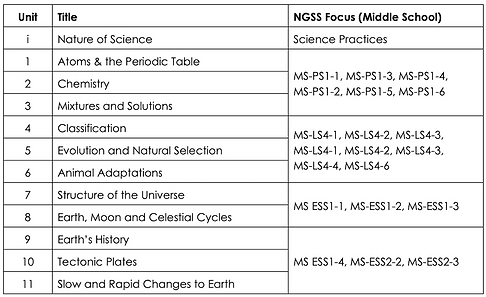

In the 2026-2027 academic sessions, we are in Year 2.
Science is offered Tuesday-Thursday afternoons from 1:30p.m. - 2:30 p.m. and can be combined with our earlier Math class.